
Clinical Negligence
Introduction
Unfortunately, the healthcare system is one of the most risky services on earth. A significant number of patients suffer from adverse events, harm from care not from disease. It is estimated that one in ten inpatients and one in four outpatients suffer from adverse events, of which at least half are preventable. Some of these preventable adverse events can be considered a form of negligence.
Definition
Clinical negligence is an act (commission) or a failure to act (omission), that does not meet the level of appropriate care expected, resulting in patient injury or loss.
Commission of an act could include, for example:
-
- Administering the wrong medication
- Administering medication to the wrong patient
- Performing a procedure without patient consent
- Performing the wrong surgical procedure
Omission of an act could include, for example:
-
- Failing to conduct a proper physical examination
- Failing to perform a clinical risk assessment
- Failing to order diagnostic tests
- Failing to follow up on critical lab tests
Clinical negligence is established when a healthcare provider owes a duty of care to a patient, the duty of care was breached, and as a direct result of the breach the patient suffered harm (see back page for details).
Clinical negligence may result in a civil action by the injured party (patient or family) or a criminal prosecution by the state in case of gross negligence.
In a civil suit clinical negligence is established when all negligence elements are present based on the balance of probabilities. In a criminal prosecution negligence is established when all elements are present beyond reasonable doubt.
Successful civil prosecution may result in monetary compensation to the injured party or dependents while successful criminal prosecutions may result in a custodial sentence for the healthcare provider. Additional referral to regulatory authorities might be required in either case.
Ethical Obligations
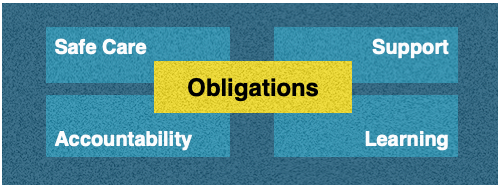
Before embarking on the legal aspects of clinical negligence, it is vital to elaborate on the ethical obligations healthcare providers have towards their patients.
First, in offering safe effective care (first do no harm) that is evidence-based and decisions made with patents and families based on clear understanding of expected benefits and risks.
Second, a patient support system that offers patients and their families advice on what to do and what to expect when things go wrong. The patient support system should include policies that support Duty of Candor (openness and honesty in such situations) including an apology by the responsible care provider, commitment to remedy the adverse event, formal complaint procedures, and financial support to overcome the financial burdens of the adverse event.
Third, a learning system that aims at preventing such events from happening again through confidential analysis and sharing of lessons learnt with other healthcare providers.
Fourth, an accountability system that has the capacity to differentiate between genuine errors and at risk behavior. In other words, when to support healthcare providers and when to refer them to the relevant regulatory authorities or more.
Governing bodies should not shy away from Duty of Candor as research has shown that what patients who have experienced an adverse or their families want is to know what has happened, what will be done to prevent such events in the future, an apology, and support till they get through this difficult time. Patients and their families file complaints or go to court only when such questions are left unanswered or they are dealt with in a harsh non-empathetic manner from their care providers.
Elements of Negligence
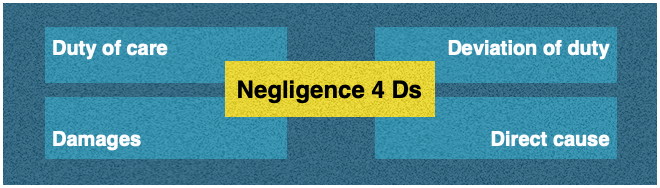
The 4 Ds of medical negligence are duty, dereliction, direct causation, and damages. All 4 Ds must be present for a claimant (person making the claim) to recover damages suffered from a negligent act. The burden of proof is on the claimant against the defendant (healthcare provider).
Duty of care
Healthcare providers have a duty of care towards their patients once that relation is established. However, that duty may extend to any patient who is admitted to the healthcare facility based on the “neighbor principle” which states that “You must take reasonable care to avoid acts or omissions which you can reasonably foresee be likely to injure your neighbor”. The principle is concerned with legal not physical proximity. For example, a patient or visitor who suffers from acute illness within a healthcare facility is owed a duty of care by any healthcare provider who happens to be there. Furthermore, senior staff have a duty of care towards patients being managed by junior colleagues under their supervision. The same duty of care applies to healthcare organizations in relation to patients under the care of their staff.
Deviation of duty
The duty of care is not absolute and healthcare providers should discharge their duties by doing what is considered reasonable according to the circumstances of the patient and situation. In healthcare, reasonableness is usually determined by a responsible body of professionals who present their opinion on what constitutes proper action in such a situation, taking into consideration the level of knowledge and skills of the healthcare provider. However, the ultimate determination of what is or is not acceptable lies with the courts who are now relying more on clinical practice guideline recommendations as objective benchmarks of practice for comparison when deciding on their judgement.
Direct cause
Establishing causation can be difficult but can be made easier by applying the “but for” test: but for the healthcare provider’s behavior the patient would not have suffered from harm. There are two limbs to the test: a question of historical fact: what actually happened and a question of hypothetical fact: what would have happened if the healthcare provider did not behave in that manner. Negligence is causative if there is a material difference in the two occasions. Example: Historical question: A patient suffered from adverse event due to drug overdose. Hypothetical question: What would have happened if the healthcare provider gave the right dose? Answer: Patient would have not suffered from the adverse event. Sometimes the causation is clear and the situation speaks for itself as in the case of wrong surgery, retained swabs or wrong patient.
Damages
In the eyes of law, patient injury is defined as any disease or any impairment of a person’s physical or mental condition. Mere grief and distress are not compensable in negligence; only recognized psychiatric illness is compensable.
Reading Material
-
- Leape L. Ethical issues in patient safety. Thorac Surg Clin. 2005;15:493-501.
- Power M and Barton A. Introduction to medical negligence law. Clinical risk. 1995;1:37-9.
- Pozgar GD. Legal and ethical essential in health care administration. 2nd. Jones and Bartlett Learning. MA. 2014.